 Harris Water Main & Sewer Contractors encounters unexpected conditions when excavating a local roadway in St. Albans Queens. It is very important to work with experienced water main & sewer contractors who are equipped to handle all circumstances and prevent a routine sewer repair from becoming an all-out disaster.
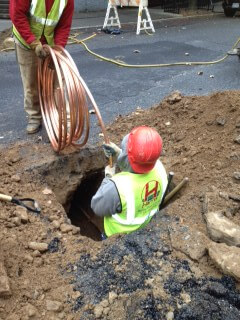
On Tuesday morning Harris Water and Sewer contractors started day 1 of what was supposed to be a 2 day sewer replacement. Excavating the property and replacing the existing clay pipe with extra heavy cast iron piping went as scheduled. There was an arborist onsite as required by the NYC Parks Department; all permits were successfully obtained with DEP, DOB and the NYC Parks. A DEP representative arrived onsite to perform a thorough inspection of the newly installed sewer line, completed and passed inspection on the pipe.
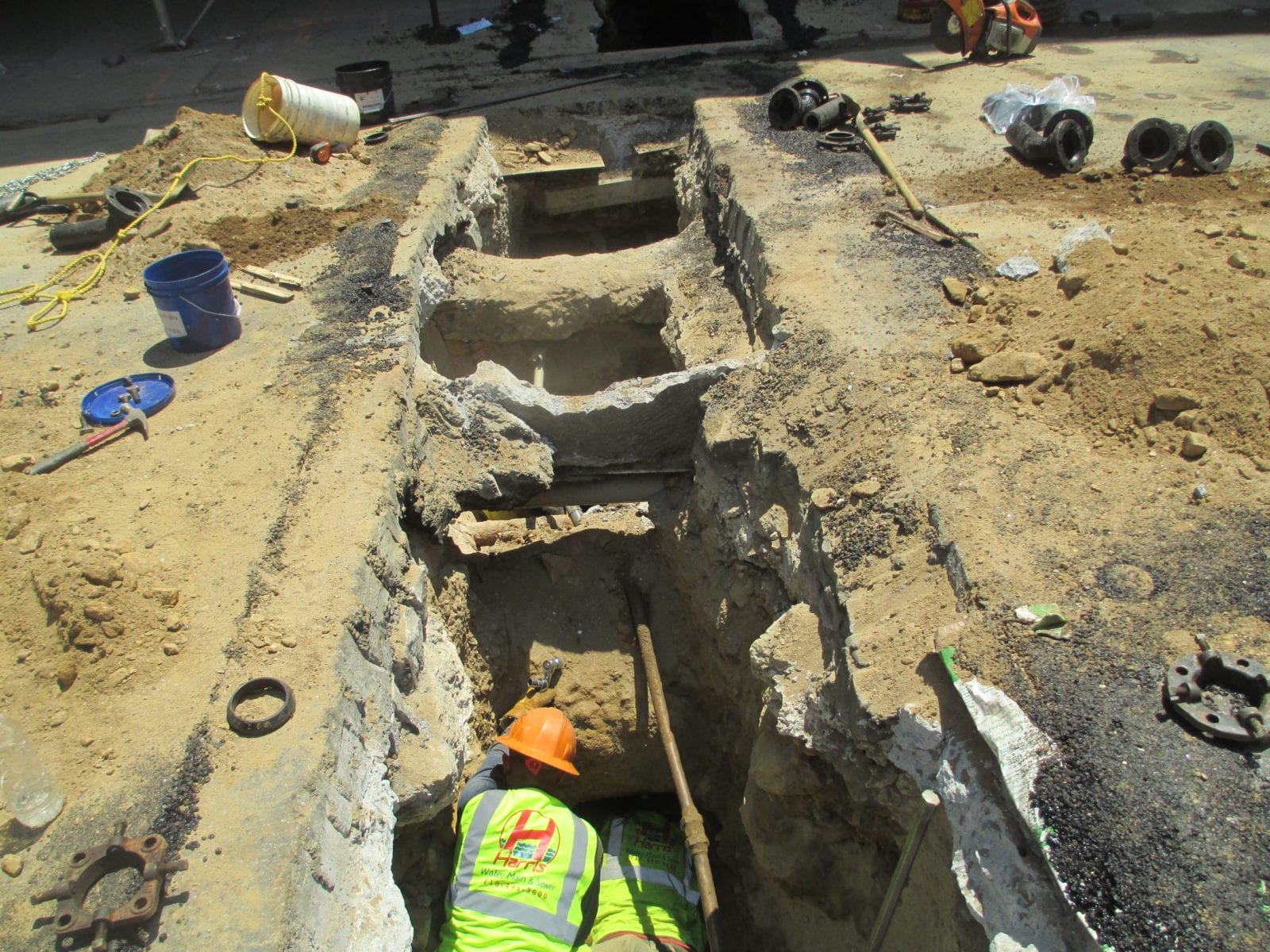
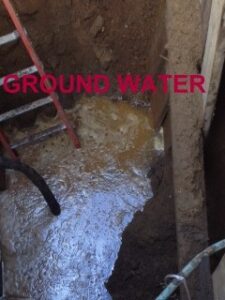
 On Wednesday morning the crew arrived onsite at 8:30 am when they began excavation of the roadway; everything was going as scheduled for the first 2 hours. The onsite foreman started to notice dampness as they approached the level of old piping, this was not completely unexpected as there was a broken sewer pipe, the crew continued to work as usual. One of the crew members started to dig by hand in the trench as they were preparing for DEP shoring requirements; he started to notice a steady stream of water coming into the trench from all sides. The foreman got into the hole and quickly declared the water as “ground water”, the team now had to act fast before these unexpected conditions caused the trench to cave in resulting in potentially dangerous conditions.
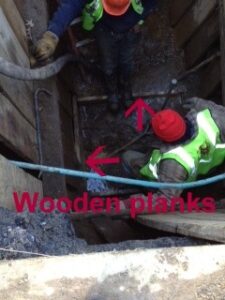
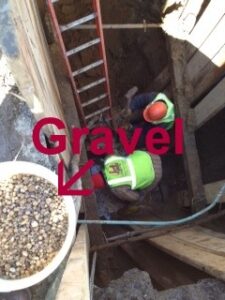
The crew now had to control the flow of water with dewatering pumps, gravel and wooden planks. The pumps were set in the sewer trench to remove the 3.5’ of water that had filled the hole. The wooden planks were inserted in the ground surrounding the area where the new pipe had to be installed and the gravel was placed around the planks creating a dam like structure. The onsite crew was able to keep the trench dry and install the new pipe in time for the final DEP inspection.
 The concrete on the sidewalk was restored the very next day along with the blacktop in the roadway, leaving another very satisfied customer.
A Brief History of St. Albans Queens
Courtesy of Wikipedia
St. Albans is a middle class community in the New York City borough of Queens around the intersection of Linden Boulevard and Farmers Boulevard, about two miles north of JFK Airport. It is southeast of Jamaica, west of Cambria Heights and north of Springfield Gardens and Laurelton. The neighborhood is part of Queens Community Board 12, and is served by the St. Albans Post Office, ZIP Code 11412.
Part of a land grant to Dutch settlers from New Netherlands Gov. Peter Stuyvesant in 1655, the area, like much of Queens, remained farmland and forest for most of the next two centuries.
By the 1800s, the plantations of four families — the Remsens, Everitts, Ludlums and Hendricksons — formed the nucleus of this sprawling farm community in the eastern portion of Jamaica Township. In 1814, when the Village of Jamaica (the first village on Long Island) was incorporated, its boundaries extended eastward to Freeman’s Path (now Farmers Boulevard), and south to Lazy Lane (called Central Avenue in 1900, then Foch Boulevard in the 1920s, and now Linden Boulevard), thus including parts of present-day St. Albans. In 1850, the Baisley Pond reservoir was set up.
In 1872, the Long Island Rail Road Cedarhurst Cut-off was built through the area, but no stop appears on the first timetables. In 1892, an area called Francis Farm was surveyed and developed for housing. There were numerous Francis families farming in the eastern portion of the Town of Jamaica in the 1880s.[9] Francis Lewis Boulevard, which does not yet appear on maps from 1909, nor in 1910,is now the eastern boundary of St. Albans.
Soon, the first street lights illuminated the crossroads that is now Linden Boulevard and Farmers Boulevard. New shops clustered around August Everitt’s lone store. By July 1, 1898, a railroad station opened where the tracks crossed Locust Avenue (now Baisley Boulevard). The station was razed and replaced with grade elimination October 15, 1935. Today, the St. Albans station provides Long Island Rail Road service to Penn Station in Midtown Manhattan or Atlantic Terminal in Brooklyn, with transfers available at Jamaica.