HomeNews & ResourcesWho Is Responsible for Replacing Concrete During Water Main & Sewer Repairs?
Who Is Responsible for Replacing Concrete During Water Main & Sewer Repairs?
News & Resources
4 MIN READ
SHARE:
When repairing water mains and sewers it is common that the concrete sidewalk in front of your home must be repaired as well as any concrete on your property. It is common to question who is responsible for the restoration? Many homeowners are concerned that the plumber may dig a big hole under the sidewalk or street and never return back to the house for final restoration. Luckily for property owner it is not that easy for a licensed and DOT bonded NYC Licensed Master Plumber to disappear before the job is completed. Once the licensed plumber obtains a DOT (Department of Transportation) permit for the water main or sewer repair he is actually responsible for the restoration over a period of three years.
Even in a scenario where the plumber completed the restoration and two years later the sidewalk starts to sink, the plumber is still responsible to re-do the restoration. In a case like this both the DOT and plumber will begin investigation as it is not the norm for a sidewalk to collapse. If it is proven that the sinking sidewalk is due the restoration completed two years prior the DOT will require the plumber to restore the sidewalk in a timely manner.
In most cases the licensed plumber is responsible for restoring any areas of concrete disturb during the water main or sewer installation. However, there are a few scenarios when the plumber may not be responsible:
If the installation is for a new building and the GC is working under a restoration plan that requires the entire frontage of the building to be restored. In this case the plumber should leave the property safe with temporary asphalt until the building is restoring all of the concrete in full.
If another utility contractor had excavated the same area and is planning on entering the same hole once your plumber is completed with the repair work. The rule of thumb under DOT regulations requires the last contractor in the excavation to be responsible for the final restoration. If there is any debate or confusion over this it is usually in the best interest of the plumber to complete the restoration and avoid any potential DOT violations for incomplete restoration.
If the broken sewer or water main had completely washed out all of the earth below the sidewalk it may not necessarily be the responsibility of the plumber to restore the entire sidewalk. A situation like this would require an onsite DOT meeting with the plumber to determine who is going to be responsible for what.
If the water or sewer repair is being completed through your insurance company there is a possibility that the coverage excludes the cost for concrete restoration. It is always suggested to check with your insurance company for clarity.
Where is plumber digging?
First it is important to understand where your plumber will be excavating which will assist in understanding all of the restoration requirements. In some cases the licensed plumber may not know the exact location of where the concrete restoration will be required but he should be able to provide a good idea based on experience.
For example, if the plumber is installing a new water main the excavation is usually directly in front of the point where the pipe is entering the building. The plumber will mark out the projected areas for excavation with green paint as a guide.
It is always in the best interest for the plumber to excavate as little as possible and stay within the original estimated time frame and excavations to complete the sewer or water main repair work. In some cases the contractor may encounter utilities below ground which will result in additional excavation resulting in additional restoration of concrete.
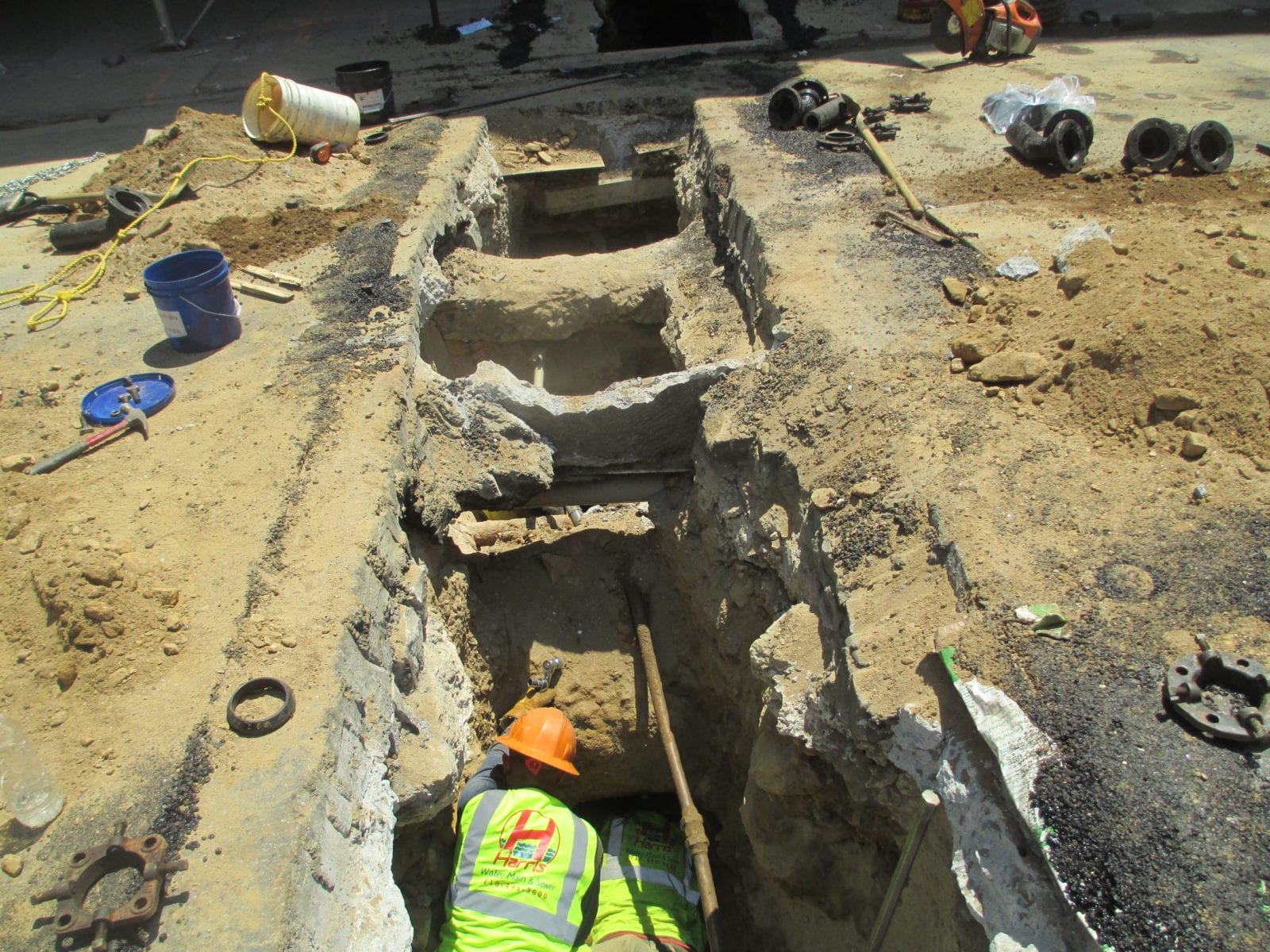
In a scenario like the above picture the crew planned on excavating a much smaller hole in the roadway for the water main and sprinkler main repair. Once the grounds were excavated we encountered unexpected utilities which required us to make a much larger excavation than anticipated and as a result there was 35% more restoration to be completed. In this case the plumber is still responsible for the restoration.
In another scenario we were prepared to being excavating the sidewalk for a standard sewer repair when we became aware that the entire sidewalk had been completely hollowed out due to the sewer leaking over a period of years.
This sewer leak was so severe and had been going on for so long the tree actually started to collapse. In this case the NYC Parks Dept. and DOT got involved to assist in formulating a game plan for responsibility. The result was that the homeowner and plumber were still responsible for removing additional sections of the sidewalk but the Parks Dept. took over the collapsing tree as it had to be cared for by a professional.
How do you know the plumber will complete restoration up to DOT standards?
Luckily for property owners throughout NYC the DOT has hundreds of field inspectors reviewing the sidewalks and roadways in each borough. If there is any issue with the concrete restoration the plumber will receive a C.A.R (corrective action notice) requiring the plumber to obtain a permit and correct the issue within 14 days.
When the inspector completes the re-inspection he refers back to the initial C.A.R. and if any issues at all the plumber is notified with another C.A.R. and may even issue a violation pending on the severity of the issue.
It is always in the plumbers best interest to correct the issue and avoid any summons. The cost of a summons is most likely more costly than the required repair. If the plumber receives a violation he is still responsible for the repairing the initial issue as well as the cost of the summons.

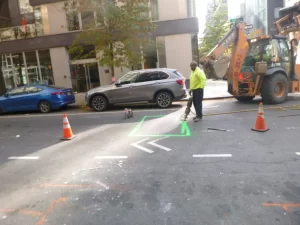 First it is important to understand where your plumber will be excavating which will assist in understanding all of the restoration requirements. In some cases the licensed plumber may not know the exact location of where the concrete restoration will be required but he should be able to provide a good idea based on experience.